The ESG Ecosystem of a University
Building the Engine for a Sustainable Future
Building the Engine for a Sustainable Future
By Datuk Dr Roziah Mohd Janor
RMJ Nexus Global – Article 3
Beyond Sustainability: Reimagining the University as an ESG Ecosystem
In an era defined by climate uncertainty, technological disruption, social inequities, and governance challenges, universities can no longer be viewed solely as institutions of teaching and research. They must evolve into dynamic ecosystems that shape the future of society. This transformation requires a holistic commitment to Environmental, Social, and Governance (ESG) principles—not as a reporting framework, but as a way of thinking, leading, and creating impact.
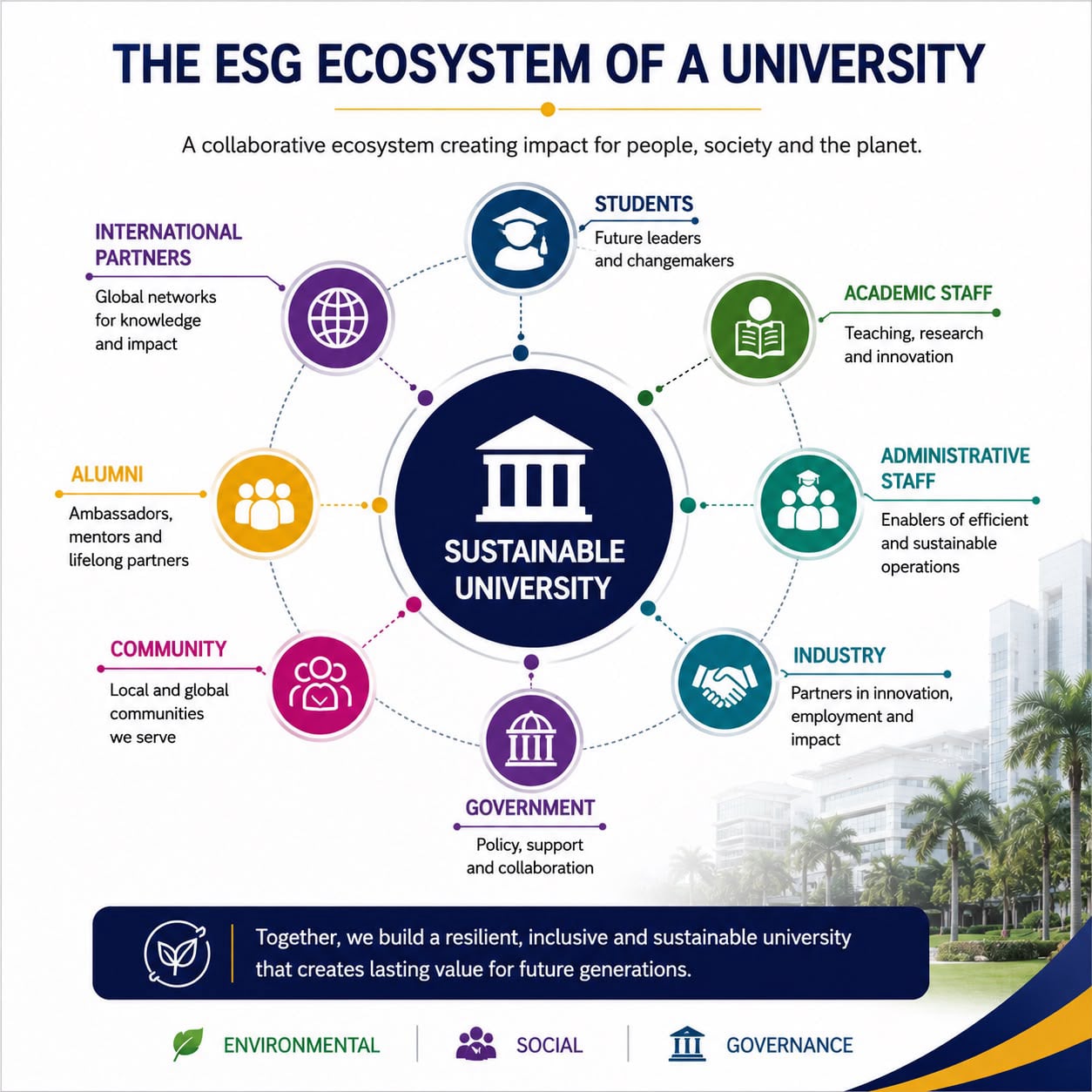
The university of the future is not merely a sustainable campus. It is an interconnected ESG ecosystem where students, academics, administrators, industry partners, government agencies, alumni, communities, and international collaborators collectively create solutions for the challenges of our time.
As UNESCO emphasizes, higher education institutions occupy a unique position in advancing sustainable development through education, research, innovation, and societal engagement. Their influence extends far beyond the classroom, shaping the knowledge, values, and leadership needed to achieve the Sustainable Development Goals (SDGs).
The question therefore is no longer whether universities should embrace ESG. The real question is how universities can leverage ESG as a strategic engine to create long-term value for people, society, and the planet.
Understanding the University ESG Ecosystem
An ESG ecosystem recognizes that sustainability is not the responsibility of a single office, department, or committee. Rather, it emerges from the interactions of multiple stakeholders who contribute different forms of knowledge, resources, and influence.
At the center of this ecosystem lies the Sustainable University—an institution that integrates environmental stewardship, social responsibility, and ethical governance into every aspect of its mission.
The ecosystem comprises eight interconnected stakeholder groups:
1. Students: Future Leaders and Changemakers
Students are not passive recipients of knowledge. They are co-creators of sustainable solutions.
Through sustainability-focused curricula, experiential learning, entrepreneurship, and civic engagement, students develop the competencies required to navigate a complex and rapidly changing world. Universities that embed ESG principles into learning experiences are preparing graduates not only for employment but also for responsible citizenship and leadership.
The future of sustainability depends on what students learn today and how they apply that knowledge tomorrow.
2. Academic Staff: Catalysts of Knowledge and Innovation
Academics play a critical role in generating the research, innovations, and thought leadership necessary to address global challenges.
Whether investigating climate resilience, artificial intelligence ethics, circular economy models, public health solutions, or social inclusion strategies, researchers contribute directly to sustainable development outcomes.
Research becomes most impactful when it transcends disciplinary silos and addresses real-world problems through collaboration and transdisciplinary approaches.
3. Administrative Staff: Enablers of Sustainable Operations
While academics create knowledge, administrative professionals ensure that sustainability is embedded in institutional operations.
Procurement policies, energy management, waste reduction, digital transformation, financial stewardship, and human resource practices all influence an institution’s ESG performance.
Sustainability succeeds when operational excellence aligns with institutional purpose.
4. Industry: Partners in Innovation and Impact
Industry partnerships bridge the gap between knowledge creation and practical implementation.
Through collaborative research, internships, technology transfer, entrepreneurship ecosystems, and workforce development initiatives, industry becomes a key driver of innovation and societal impact.
An ESG-oriented university works with industry not merely to enhance employability but to co-create sustainable solutions that generate economic, social, and environmental value.
5. Government: Enabling Policy and Collaboration
Government institutions provide the policy frameworks, funding mechanisms, and regulatory environments that support sustainable transformation.
Effective university-government partnerships enable evidence-based policymaking, foster innovation ecosystems, and accelerate progress toward national and global sustainability goals.
Universities contribute knowledge; governments provide scale. Together, they create systemic change.
6. Communities: The Heart of Social Impact
Universities exist within communities and have a responsibility to serve them.
Community engagement transforms sustainability from an academic concept into a lived reality. Through outreach, social innovation, lifelong learning, healthcare initiatives, and capacity-building programmes, universities become active contributors to societal well-being.
A truly sustainable university measures success not only by rankings and publications but also by the positive difference it makes in people’s lives.
7. Alumni: Lifelong Partners in Transformation
Alumni represent one of the most powerful yet often underutilized assets within a university ecosystem.
As leaders, professionals, entrepreneurs, policymakers, and philanthropists, alumni extend the institution’s impact far beyond campus boundaries.
They serve as mentors, ambassadors, collaborators, and advocates who reinforce the university’s sustainability mission across generations.
8. International Partners: Expanding Global Impact
Sustainability challenges do not recognize national borders.
International partnerships enable universities to share knowledge, benchmark best practices, undertake collaborative research, and address global issues through collective action.
In a connected world, the ability to build global networks is increasingly essential for achieving meaningful and scalable impact.
ESG as the Operating System of a Sustainable University
Many institutions approach ESG as a compliance exercise or reporting requirement. This perspective is insufficient.
ESG should function as the university’s operating system—guiding decisions, behaviours, investments, partnerships, and performance metrics.
Environmental Stewardship
Universities have a responsibility to reduce their ecological footprint while contributing solutions to environmental challenges.
This includes:
● Carbon reduction strategies
● Renewable energy adoption
● Sustainable campus design
● Circular resource management
● Climate resilience initiatives
● Sustainability-focused research and innovation
Environmental stewardship demonstrates that universities can lead by example.
Social Responsibility
The social dimension of ESG reflects a university’s commitment to human development.
This encompasses:
● Inclusive and equitable education
● Diversity, equity, and inclusion
● Student well-being
● Community engagement
● Social innovation
● Lifelong learning opportunities
A socially responsible university ensures that no one is left behind in the pursuit of progress.
Governance Excellence
Governance is the foundation upon which sustainability efforts succeed.
Strong governance requires:
● Ethical leadership
● Transparency and accountability
● Stakeholder engagement
● Data-driven decision-making
● Risk management
● Institutional integrity
Without effective governance, even the most ambitious sustainability initiatives struggle to achieve lasting impact.
Transforming Universities into Engines of the Sustainable Future
The most successful universities of the coming decades will not be those with the largest campuses or highest budgets. They will be those that create the greatest societal value.
To become engines of sustainable futures, universities must move from isolated initiatives to ecosystem thinking.
This means:
● Integrating ESG into institutional strategy.
● Embedding sustainability across teaching, research, and operations.
● Strengthening partnerships across sectors.
● Measuring impact beyond traditional academic metrics.
● Aligning institutional priorities with the SDGs.
● Cultivating leaders capable of navigating complexity and uncertainty.
The United Nations Higher Education Sustainability Initiative (HESI) recognizes that higher education institutions are uniquely positioned to accelerate sustainable development through multi-stakeholder collaboration, knowledge generation, and capacity building.
In essence, universities are among society’s most powerful platforms for systemic change.
A Call for Purpose-Driven Higher Education
The future demands universities that are not only intelligent but also responsible; not only innovative but also inclusive; not only globally connected but also locally relevant.
An ESG ecosystem provides the architecture for achieving this vision.
When students become changemakers, academics become solution providers, administrators become enablers, industry becomes a co-creator, governments become partners, communities become beneficiaries, alumni become ambassadors, and international networks become amplifiers of impact, the university transcends its traditional role.
It becomes an engine of sustainable futures.
The journey towards sustainability is not a destination but a continuous process of transformation. Universities that embrace ESG as a collaborative ecosystem will not merely respond to global challenges—they will help define the solutions.
And in doing so, they will create lasting value for future generations.